Can You Cancel a Licensed Moneylender Loan in Singapore? New Cooling-Off Rule Explained.
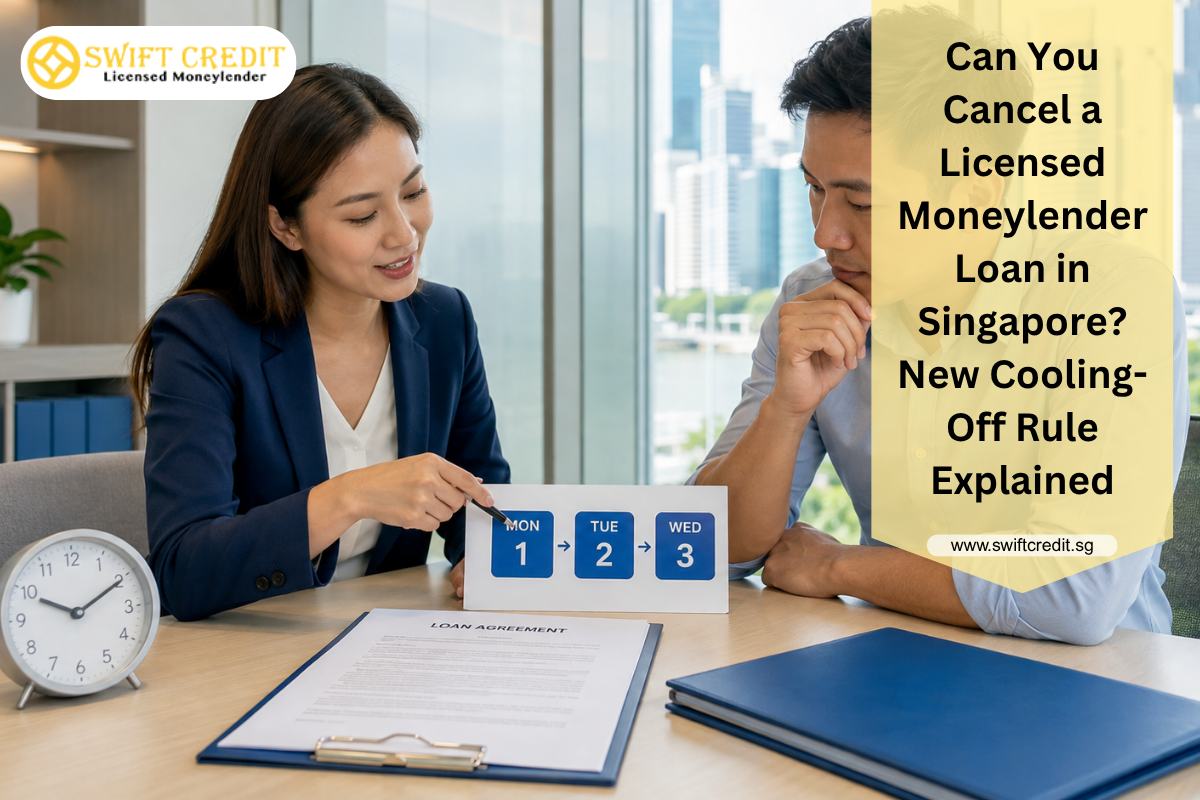
Yes—from 15 September 2026, borrowers will be able to cancel certain unsecured loans from licensed moneylenders during a new mandatory three-business-day cooling-off period.
The new rule gives eligible borrowers additional time to reconsider whether they still need the loan or can afford the repayment commitment. A qualifying loan may be cancelled during this period at a reduced cost, without interest being charged for the cancellation.
However, cancellation is not automatic, and the borrower must return the money received together with any permitted portion of the loan approval fee.
If you are searching for information on how to cancel a licensed moneylender loan in Singapore, this guide explains the new rules, which loans qualify and how much you may need to repay.
What Is the New Three-Business-Day Cooling-Off Period?
The Ministry of Law announced that a mandatory cooling-off period of three business days will apply to eligible unsecured loans taken from licensed moneylenders.
The measure takes effect on 15 September 2026.
During this period, a borrower may reconsider the loan and request cancellation at a reduced cost. The licensed moneylender may retain only a limited portion of the loan approval fee, and no interest will be charged for a valid cancellation made within the cooling-off period.
This gives borrowers a short window to reassess the decision after funds have been disbursed.
What Counts as a Business Day?
The three-day cooling-off period is measured using business days, not ordinary calendar days.
The following days are excluded:
- Saturdays
- Sundays
- Public holidays in Singapore
This means a weekend or public holiday may extend the date by which a borrower must act. However, borrowers should not assume their deadline without checking.
If you intend to cancel a loan, contact the licensed moneylender promptly and ask for confirmation of the applicable cancellation deadline.
Which Licensed Moneylender Loans Qualify?
The new cooling-off period applies to unsecured loans other than business loans.
Eligible loan types may include:
- Unsecured personal loans
- Payday loans
- Monthly instalment loans
- Foreigner loans taken for personal purposes
- Other unsecured consumer loans
A loan is unsecured when the borrower is not required to pledge property, a vehicle or another asset as collateral.
Borrowers can learn more about this type of financing on Swift Credit’s personal loan Singapore page.
Are Business Loans Covered by the New Rule?
No. Business loans are excluded from the announced cooling-off-period framework.
If a loan was taken for commercial or business purposes, borrowers should refer to the terms of their agreement and speak directly with the lender about available settlement or cancellation options.
It is important to identify the actual purpose and classification of the loan instead of assuming that every loan from a licensed moneylender is covered.
What Does “Cancel at a Reduced Cost” Mean?
Cancelling a licensed moneylender loan during the cooling-off period does not mean the borrower can keep the funds or walk away without repaying anything.
A borrower will generally need to repay:
- The remaining amount disbursed after the upfront loan approval fee was deducted; and
- The permitted portion of the approval fee that the licensed moneylender is allowed to retain.
For a qualifying cancellation:
- No interest will be charged.
- The lender may retain only a limited portion of the approval fee.
- The total amount repaid cannot exceed the original loan principal.
The approval-fee limits depend on whether the loan principal is S$5,000 or less, or more than S$5,000.
Cancellation Fee for Loans of S$5,000 or Less
For an eligible loan with a principal amount of S$5,000 or less, the licensed moneylender may retain a maximum of S$50.
However, the lender cannot retain more than the approval fee originally charged.
For example, if the approval fee was only S$30, the lender cannot retain S$50. The amount retained would be limited to the actual S$30 approval fee.
Cancellation Fee for Loans Above S$5,000
For an eligible loan with a principal amount of more than S$5,000, the licensed moneylender may retain up to 3.5% of the principal amount.
Once again, the lender cannot retain more than the approval fee actually charged.
If 3.5% of the principal is S$350 but the original approval fee was S$200, the maximum retained amount would be S$200—not S$350.
Example: Cancelling a S$1,000 Loan
Suppose a borrower obtains a loan with a principal amount of S$1,000.
If a 10% approval fee of S$100 is deducted upfront, the borrower receives S$900.
The borrower then decides to cancel within the three-business-day cooling-off period.
The amount repayable may be up to:
- S$900 received by the borrower; plus
- S$50 as the maximum permitted portion of the approval fee.
The borrower would therefore repay up to S$950, with no interest charged for the qualifying cancellation.
Example: Cancelling a S$10,000 Loan
Suppose a borrower takes a S$10,000 loan and is charged an approval fee of S$200.
After the fee is deducted, the borrower receives S$9,800.
For a loan above S$5,000, the permitted limit is up to 3.5% of the principal. Although 3.5% of S$10,000 is S$350, the lender cannot retain more than the S$200 approval fee actually charged.
The borrower would therefore repay up to:
- S$9,800 received; plus
- S$200 from the approval fee.
The total cancellation repayment would be up to S$10,000, without interest.
How to Cancel a Licensed Moneylender Loan in Singapore
If you have decided to cancel an eligible loan, act promptly and contact the licensed moneylender through its official communication channel.
A sensible cancellation process includes the following steps:
1. Contact the lender immediately
Tell the lender clearly that you want to cancel the loan under the mandatory cooling-off-period provisions.
2. Confirm that the loan qualifies
Ask the lender to confirm whether the loan is an eligible unsecured, non-business loan and whether the request was made within the three-business-day period.
3. Request a written settlement amount
The breakdown should show:
- Original principal
- Approval fee deducted
- Amount disbursed
- Permitted portion of the approval fee retained
- Interest charged, which should be zero for a qualifying cancellation
- Total amount to be returned
4. Follow the official payment instructions
Make payment only through the licensed moneylender’s verified payment method. Do not transfer funds to an unknown individual or an unverified personal bank account.
5. Obtain a receipt
Always request an official receipt showing the amount and date of payment.
6. Ask for cancellation confirmation
Obtain written confirmation that the loan has been cancelled and that there is no remaining balance under the cancelled agreement.
Keep the loan contract, correspondence, repayment breakdown, receipt and cancellation confirmation for your records.
Can You Cancel After the Cooling-Off Period Ends?
The special reduced-cost cancellation framework applies within the three-business-day cooling-off period.
Once the cooling-off period ends, the original loan contract and its repayment obligations may continue to apply. Cancelling or settling the loan later may be treated differently from a cancellation made during the statutory cooling-off period.
If you have missed the deadline, contact the lender and request a written early-settlement statement. Do not stop making scheduled repayments unless the lender confirms a different arrangement in writing.
Cooling-Off Cancellation Versus Early Settlement
Cooling-off cancellation and early settlement are not necessarily the same.
Cooling-off cancellation
- Available only during the prescribed three-business-day period
- Applies to qualifying unsecured, non-business loans
- No interest is charged for a valid cancellation
- Only a limited portion of the approval fee may be retained
Early settlement
- Usually takes place after the cooling-off period
- Governed by the loan contract and applicable requirements
- May include outstanding interest or other permitted amounts
- Requires a separate settlement calculation from the lender
Borrowers should state clearly whether they are requesting cooling-off cancellation or ordinary early settlement.
Why Was the New Cooling-Off Rule Introduced?
Borrowing decisions are sometimes made under significant pressure. A borrower may be facing an urgent bill, medical expense, temporary income delay or family emergency.
After receiving the funds, the borrower may realise that:
- The expense can be postponed
- A smaller loan would be sufficient
- The repayment is not affordable
- Another source of assistance is available
- The loan may create unnecessary financial pressure
- The money is no longer required
The cooling-off period allows the borrower to reconsider the decision while still recognising that the lender has incurred costs in processing, verifying and approving the loan.
What to Check Before Accepting Any Loan
The cooling-off period provides additional protection, but borrowers should still evaluate a loan carefully before signing.
Check the amount you will actually receive
The approved principal and the amount disbursed may differ because the approval fee can be deducted upfront.
Review the monthly repayment
Make sure the repayment remains manageable after essential expenses such as rent, utilities, transport, food and existing debt payments.
Understand every charge
The contract should clearly state the interest rate, approval fee, repayment schedule, late interest, late fees and total repayment amount.
Borrow only what you need
Qualifying for a larger amount does not mean that borrowing the maximum is financially suitable.
Verify the lender
Confirm that the company is listed in the Ministry of Law’s Registry of Moneylenders and that its name and address match the official record.
Swift Credit provides further information through its notes to borrowers and loan eligibility guide.
Frequently Asked Questions
When does the new cooling-off period begin?
The new measure takes effect on 15 September 2026.
Is the cooling-off period three calendar days?
No. It is three business days. Saturdays, Sundays and Singapore public holidays are excluded.
Does the cooling-off period apply to personal loans?
It applies to qualifying unsecured personal loans from licensed moneylenders.
Does it apply to business loans?
No. Business loans are excluded.
Will I be charged interest if I cancel during the cooling-off period?
No interest will be charged for an eligible loan properly cancelled within the cooling-off period.
Can the lender retain part of the approval fee?
Yes. For loans of S$5,000 or less, the maximum is S$50. For loans above S$5,000, the maximum is 3.5% of the principal. The retained amount cannot exceed the approval fee actually charged.
Do I have to return the money received?
Yes. The cooling-off period allows cancellation at a reduced cost; it does not allow the borrower to keep the disbursed funds.
Should I keep proof of cancellation?
Yes. Keep the written request, repayment breakdown, payment receipt and confirmation that the loan has been cancelled.
For additional questions about licensed borrowing, visit Swift Credit’s loan FAQs.
Final Takeaway
From 15 September 2026, eligible borrowers will have three business days to reconsider certain unsecured loans taken from licensed moneylenders.
If you want to cancel a licensed moneylender loan in Singapore, contact the lender promptly, confirm that your loan qualifies and request a written calculation of the cancellation amount.
The new cooling-off period provides meaningful borrower protection, but it should not replace careful decision-making. Always understand the loan cost, repayment schedule and contractual obligations before signing.
Swift Credit Pte Ltd is a licensed moneylender in Singapore. Our team explains the loan amount, applicable fees and repayment schedule before a borrower signs an agreement. If you have questions regarding an existing Swift Credit loan or the new cooling-off framework, contact our office directly for assistance.
This article is provided for general information only and does not constitute legal or financial advice. Borrowers should refer to their loan agreement and the latest official requirements published by the Ministry of Law.