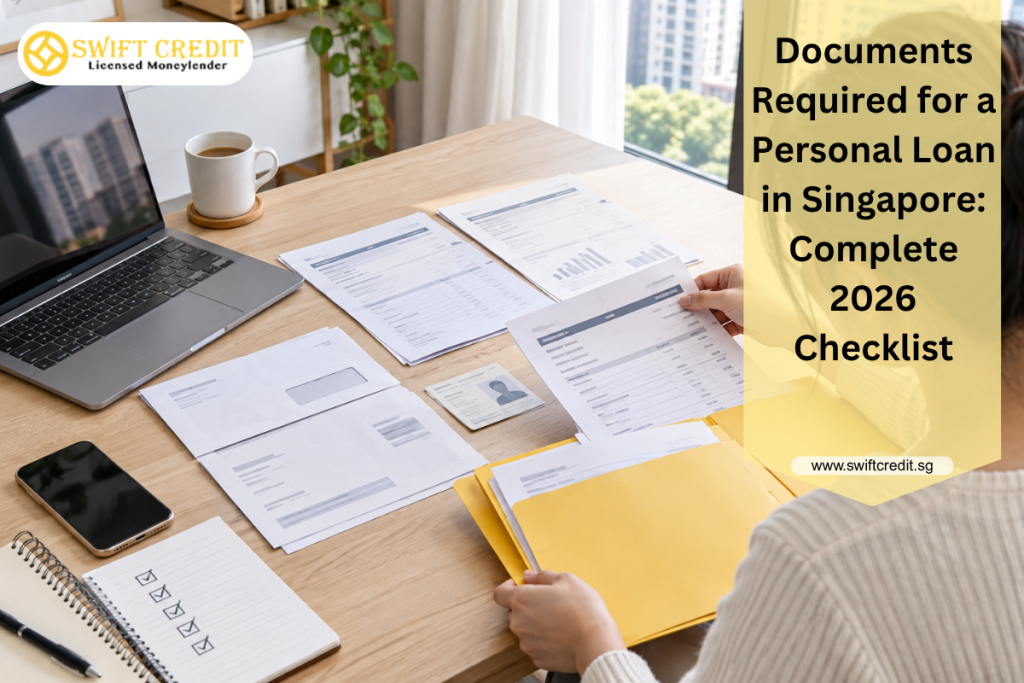
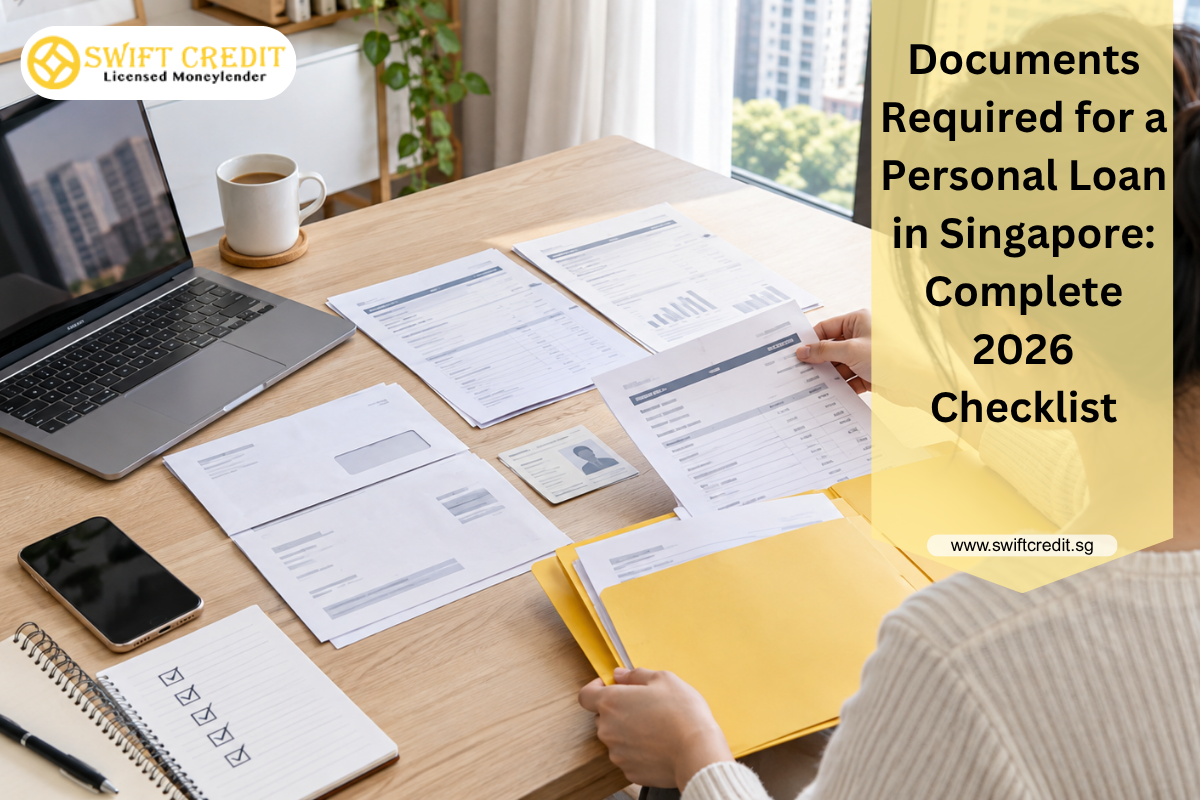
Applying for a personal loan becomes much easier when you prepare the correct documents in advance. Complete and accurate records allow the lender to confirm your identity, income, residential address and ability to manage the proposed repayments.
The exact documents required for a personal loan in Singapore depend on your employment, nationality and income structure. A salaried Singapore citizen may provide different records from a self-employed applicant, private-hire driver or foreign employee.
This guide explains the documents commonly requested by licensed moneylenders, what to prepare if you do not receive conventional payslips and how to avoid delays during the application process.
Key Takeaways
- Prepare valid identification, proof of address and proof of income.
- Document requirements vary for employees, foreigners and self-employed applicants.
- Several recent months of income records may provide a clearer financial picture.
- Singpass and MyInfo may simplify the submission process, but additional verification can still be required.
- Missing, outdated or inconsistent information may delay an application.
- A responsible licensed moneylender will not guarantee approval without assessing your documents.
- The loan contract must be explained before you sign it.
- Identity verification must be completed in person at the lender’s approved business premises before a licensed moneylender grants a loan.
Why Are Documents Required for a Personal Loan?
Loan documents help a lender verify that the applicant is genuine and that the requested repayment schedule is affordable.
A licensed moneylender may use your documents to assess:
- Your identity and legal residency status
- Your current residential address
- Employment or business activity
- Average monthly income
- Existing financial commitments
- Current licensed moneylender loans
- Repayment history
- Requested loan amount
- Proposed repayment period
- Disposable income after essential expenses
Providing documents does not guarantee approval. The lender must still assess whether the loan is suitable based on your individual financial circumstances.
Be cautious if someone offers guaranteed approval without checking your identity, income or existing commitments.
Basic Documents Required from Most Applicants
Although requirements vary, most applicants should prepare the following categories of documents.
1. Valid identification
Singapore citizens and permanent residents will normally need a valid NRIC.
Foreign applicants may need:
- Passport
- Employment Pass
- S Pass
- Work Permit
- Dependant’s Pass
- Long-Term Visit Pass
- Other valid immigration or employment documents
The name and identification number should be consistent across the application and supporting records.
2. Proof of residential address
Your identity document may show your registered address, but the lender may request additional proof of where you currently live.
Accepted records may include:
- Utility bill
- Telecommunications bill
- Tenancy agreement
- Bank statement
- Government correspondence
- Employment letter showing your address
- Other recent official correspondence
The document should normally be recent and clearly show your full name and residential address.
3. Proof of income
Income documents help the lender assess whether the proposed repayments are manageable.
Depending on your circumstances, these may include:
- Recent payslips
- Bank statements showing salary deposits
- CPF contribution history
- IRAS Notice of Assessment
- Employment contract
- Commission statements
- Platform earnings reports
- Customer invoices
- Business bank statements
- Financial accounts
4. Employment information
You may be asked to provide:
- Employer’s name
- Workplace address
- Job title
- Employment commencement date
- Employment contract
- Human-resources contact details
- Evidence of probation or permanent employment status
The lender may conduct reasonable checks to confirm that the information is accurate.
5. Bank account information
A recent bank statement may be needed to confirm:
- Your name and account ownership
- Salary or business-income deposits
- Regular financial commitments
- Existing deductions
- Normal cash flow
Never provide your online banking password, ATM PIN or one-time password to a lender or loan agent.
Document Checklist for Salaried Singapore Citizens and PRs
Salaried employees generally have a straightforward income trail.
Prepare:
- NRIC
- Recent payslips
- Recent bank statements showing salary deposits
- CPF contribution history
- Latest IRAS Notice of Assessment, if requested
- Proof of current residential address
- Employment contract or confirmation letter, if required
- Details of existing loans and regular financial commitments
Your payslip, CPF record and bank deposit should generally support the income stated in your application.
If you recently changed jobs, prepare your new employment contract and any available payslips from both your previous and current employers. The lender may need additional information because the new employment record is short.
Document Checklist for Foreign Employees
Foreign applicants must demonstrate that they are legally residing and working in Singapore.
Common foreigner loan documents in Singapore include:
- Valid passport
- Valid work or residence pass
- Recent payslips
- Employment contract
- Recent bank statements
- Proof of Singapore residential address
- Employer’s name and contact details
- Remaining validity of the applicant’s work pass
- Evidence of existing loan commitments
The proposed repayment period may be considered alongside the remaining validity of your employment or immigration pass.
Foreign applicants should review Swift Credit’s Foreigner Loan page before applying.
Documents for Self-Employed Applicants
Self-employed applicants may not receive fixed monthly payslips or employer CPF contributions. Instead, they may need to demonstrate their earnings through several supporting records.
Useful documents include:
- NRIC or passport
- ACRA business profile
- IRAS Notice of Assessment
- Personal bank statements
- Business bank statements
- Customer invoices and receipts
- Service agreements or customer contracts
- Commission statements
- Business financial accounts
- CPF or MediSave records
- Proof of residential address
Gross business revenue should not automatically be presented as personal income. Business expenses—including rent, inventory, transport, platform charges and employee costs—can reduce the amount available for personal expenses and loan repayments.
Keeping business and personal transactions in separate bank accounts may make your income easier to assess.
Documents for Freelancers and Gig Workers
Freelancers, delivery riders, private-hire drivers and other platform workers often receive variable income.
They may provide:
- Platform earnings statements
- Weekly or monthly payout reports
- Bank statements showing platform deposits
- Customer invoices
- Payment receipts
- Service contracts
- IRAS Notice of Assessment
- Relevant vehicle rental or operating-cost records
- Proof of address and identification
Provide a representative period rather than only submitting your highest-earning week.
For example, several months of statements can help demonstrate whether your income is reasonably consistent after expenses.
Can You Apply Without Payslips?
You may still submit an application if you genuinely do not receive conventional payslips. However, you will usually need alternative evidence of income.
Possible alternatives include:
- Bank statements showing regular income deposits
- CPF contribution history
- IRAS Notice of Assessment
- Employment contract
- Commission statements
- Platform earnings records
- Customer invoices and receipts
- Business financial statements
A lender cannot properly assess affordability based only on a verbal estimate of your income.
Advertisements promising a “no-document loan” or guaranteed approval should be treated cautiously, especially if the advertiser requests an upfront payment or communicates only through WhatsApp, SMS or social media.
Does Singpass or MyInfo Replace Loan Documents?
Singpass and MyInfo may make it easier to provide selected identity, employment and income details. They can reduce manual form filling and help ensure that the submitted information is accurate.
However, they do not necessarily eliminate every document requirement.
Additional documents may still be requested when:
- Your income is variable
- You recently changed employment
- You are self-employed
- Your address has changed
- Your application information is incomplete
- Your bank deposits do not match your declared income
- The lender needs to clarify existing commitments
An online submission is also not the final loan transaction. Licensed moneylenders must verify borrowers in person at their approved place of business before granting a loan.
What If Your Income Is Paid in Cash?
Cash income can be more difficult to verify because there may be no automatic salary entry in a bank account.
If you are regularly paid in cash, useful supporting evidence may include:
- Employer-issued payslips
- Signed salary acknowledgements
- Employment contract
- CPF contribution records
- IRAS income records
- Customer invoices and receipts
- Consistent bank deposits supported by business records
Unexplained cash deposits may not be sufficient evidence by themselves.
Where practical, deposit legitimate business or employment income consistently and keep documents showing where each payment originated.
Why Do Loan Applications Get Delayed?
Missing documents
An application cannot be assessed efficiently when key identification, address or income records are absent.
Expired identification or work pass
An expired passport or employment pass cannot reliably establish your current legal status.
Inconsistent income information
Your declared salary should be reasonably consistent with your payslips, bank deposits, CPF contributions and tax records.
Unclear bank statements
Screenshots with missing names, dates or account details may not be accepted. Submit complete and legible statements when requested.
Outdated proof of address
An old bill or correspondence may not confirm where you currently live.
Unexplained transactions
Large deposits, transfers between your own accounts and irregular payments may require clarification.
Undisclosed existing loans
Licensed moneylenders may review relevant borrowing information through the Moneylenders Credit Bureau. Incomplete information about existing commitments can affect the assessment.
Read Swift Credit’s guide to the MLCB report in Singapore to understand the information licensed moneylenders may review.
How to Prepare Your Documents
Check that every document is current
Review the validity dates on your passport, work pass and identification records. Use recent bank statements and proof of address.
Make sure the information matches
Your name, identification number, address, employer and income should be consistent across all records.
If there is a genuine difference—for example, you recently changed address—prepare evidence explaining the change.
Submit clear copies
Make sure each document is:
- Fully visible
- Legible
- Unedited
- Not cropped excessively
- Showing the relevant date
- Showing your name where required
Do not alter a payslip, bank statement, invoice or government record. Providing false information may result in rejection and could create legal consequences.
Organise records by category
Arrange your documents into:
- Identification
- Address
- Employment
- Income
- Bank records
- Existing loan commitments
This makes it easier to identify anything missing before submitting your application.
Calculate an affordable amount
Document preparation should include reviewing your own budget.
List your:
- Housing expenses
- Utilities
- Food and transport costs
- Insurance
- Family commitments
- Existing loan repayments
- Credit-card payments
- Business expenses
- Medical expenses
Use Swift Credit’s loan calculator to estimate repayments, but remember that online calculations are illustrative and do not represent guaranteed approval or final terms.
What Should You Check Before Signing?
Having your documents approved does not mean you must immediately accept the loan.
Before signing, confirm:
- Loan principal
- Amount you will actually receive
- Administrative fee
- Monthly interest rate
- Repayment frequency
- Number of instalments
- Amount of each instalment
- Total repayment amount
- Late-payment consequences
- Early-settlement procedure
- Loan-cancellation rights, where applicable
The Ministry of Law’s borrower guide states that licensed moneylenders may charge interest of up to 4% per month, an administrative fee of up to 10% of the loan principal and a late fee of up to S$60 for each month of late repayment. Late interest is limited to the overdue amount.
The actual rate and charges offered must be stated clearly in your loan contract.
How to Protect Your Personal Documents
Loan applications involve sensitive personal and financial information. Only submit documents through the lender’s official channels.
Do not send documents to someone who:
- Contacts you with an unsolicited loan offer
- Uses an unverified personal mobile number
- Requests an upfront processing payment
- Asks for your Singpass password
- Requests your bank password, PIN or OTP
- Guarantees approval before assessment
- Refuses to identify the lender’s registered company
- Claims the loan can be completed entirely online
- Asks you to meet somewhere other than the approved office
Verify the lender’s company name and address through the Registry of Moneylenders’ official list before submitting sensitive information.
Swift Credit Pte Ltd conducts its required in-person loan process at its registered office at 192 Waterloo Street, #02-06 Skyline Building, Singapore 187966.
Frequently Asked Questions
What documents are required for a personal loan in Singapore?
Most applicants should prepare identification, proof of residential address, income records, employment information and recent bank statements. Requirements vary according to nationality and employment type.
How many months of payslips are needed?
The required period depends on the lender and applicant’s circumstances. Prepare several recent payslips and corresponding bank statements so your income can be verified.
Can I apply for a personal loan without CPF contributions?
Applicants without regular employer CPF contributions may still apply, but alternative income records will normally be required. These can include bank statements, tax records, invoices or platform earnings statements.
Can a self-employed person apply?
Yes, subject to assessment. Self-employed applicants may need an ACRA profile, tax documents, bank statements, invoices and other evidence of recurring income.
Can foreigners apply for a personal loan?
Foreigners legally residing in Singapore may apply, subject to the lender’s assessment. A valid passport, work or residence pass, income records and proof of Singapore address may be required.
Does submitting all the documents guarantee approval?
No. Complete documents allow the application to be assessed, but approval depends on income, existing debt, repayment history, affordability and other relevant factors.
Can I complete the entire application online?
You may submit preliminary information online, but a licensed moneylender must complete face-to-face identity verification at its approved business premises before granting the loan.
Should I give a lender my Singpass password?
No. Never disclose your Singpass password, banking credentials, ATM PIN or one-time password. Official digital authorisation should be completed securely by the account holder.
What happens if my address on my NRIC is outdated?
Update your official records where required and prepare recent proof of your current address. Inform the lender about the discrepancy rather than attempting to conceal it.
Why was I asked for additional documents?
Additional records may be required when income varies, information does not match, employment is recent or the lender needs to clarify existing financial commitments.
Final Thoughts
Preparing the correct documents required for a personal loan in Singapore can help make your application clearer and reduce avoidable delays.
Salaried employees should prepare identification, payslips, CPF records and bank statements. Foreign applicants should also check that their passport and work or residence pass remain valid. Self-employed individuals and gig workers may need tax records, invoices, platform statements and business bank records to demonstrate their actual income.
Always provide complete and accurate information. Avoid lenders or agents who promise guaranteed approval, request an advance payment or ask for confidential passwords.
Review Swift Credit’s personal loan options and eligibility requirements before applying. Every application remains subject to assessment, document verification and approval.
This article provides general information and does not constitute financial advice. Loan availability and terms depend on individual assessment and applicable regulations.