The maximum personal loan amount in Singapore depends on your income, existing borrowing and the type of lender you approach. If you are considering a personal loan in Singapore from a licensed money lender in Singapore such as Swift Credit, the key distinction is between the legal borrowing ceiling and the amount approved after assessment.
For unsecured borrowing from licensed moneylenders, individuals earning at least S$20,000 annually can borrow up to six times their monthly income across all licensed moneylenders combined. Lower-income borrowers face fixed-dollar limits. Banks apply separate product limits and regulatory rules, so there is no single maximum that applies to every personal loan.
Maximum Personal Loan Amount in Singapore: A Quick Comparison
Most ordinary personal loans are unsecured, meaning you do not pledge an asset as collateral. The main limits differ according to where you borrow.
| Borrowing Route | Relevant Limit | What It Means |
|---|---|---|
| Licensed moneylenders, annual income of at least S$20,000 | Six times monthly income | Applies across all licensed moneylenders combined, not separately at each lender |
| Licensed moneylenders, annual income below S$20,000 | S$500 or S$3,000 | Depends on annual income and citizenship or residency status |
| Banks and other financial institutions | Product-specific limits, alongside applicable MAS rules | Advertised maximums remain subject to eligibility, available credit and assessment |
The maximum personal loan amount in Singapore is therefore not necessarily the amount you can receive from one application. Existing loans can reduce your remaining borrowing capacity, while a lender may approve less than the legal ceiling.
Unsecured Borrowing Limits for Licensed Moneylenders
The Ministry of Law’s Notes to Borrowers sets out the following aggregate limits for unsecured borrowing.
| Annual Income | Singapore Citizens and Permanent Residents | Foreigners Residing in Singapore |
|---|---|---|
| Less than S$10,000 | S$3,000 | S$500 |
| At least S$10,000 but less than S$20,000 | S$3,000 | S$3,000 |
| At least S$20,000 | Six times monthly income | Six times monthly income |
These are combined limits across all licensed moneylenders. Taking loans from several lenders does not multiply your permitted borrowing amount.
Why the S$20,000 Income Threshold Matters
Do not apply the six-times formula automatically if your annual income falls below S$20,000. A Singapore citizen earning S$18,000 annually remains subject to the S$3,000 cap, even though six times their average monthly income would be S$9,000.
For a foreign resident earning less than S$10,000 annually, the corresponding limit is S$500. Once annual income reaches S$10,000, the fixed cap rises to S$3,000 until the S$20,000 threshold is reached.
When calculating the maximum personal loan amount in Singapore, identify your income band before multiplying any monthly figure.
How Secured Loans Differ
MinLaw distinguishes secured loans from unsecured borrowing. The same income-based unsecured limits do not apply to secured loans, but this does not mean unlimited funding is available. The collateral, lender’s assessment and contractual terms still determine the amount offered.
How to Calculate Your Remaining Borrowing Capacity
Establish the Monthly Income Accepted by the Lender
For borrowers in the six-times-income band, the starting calculation is:
Aggregate unsecured borrowing ceiling = assessed monthly income × 6.
The examples below assume stable monthly income, annual income of at least S$20,000 and no existing unsecured moneylender loans.
| Assessed Monthly Income | Corresponding Annual Income | Aggregate Borrowing Ceiling |
|---|---|---|
| S$2,000 | S$24,000 | S$12,000 |
| S$3,000 | S$36,000 | S$18,000 |
| S$5,000 | S$60,000 | S$30,000 |
Use documented income accepted during assessment. If you receive variable commissions, bonuses or freelance payments, do not assume that your highest-earning month will be treated as your regular monthly income.
Account for Existing Moneylender Loans
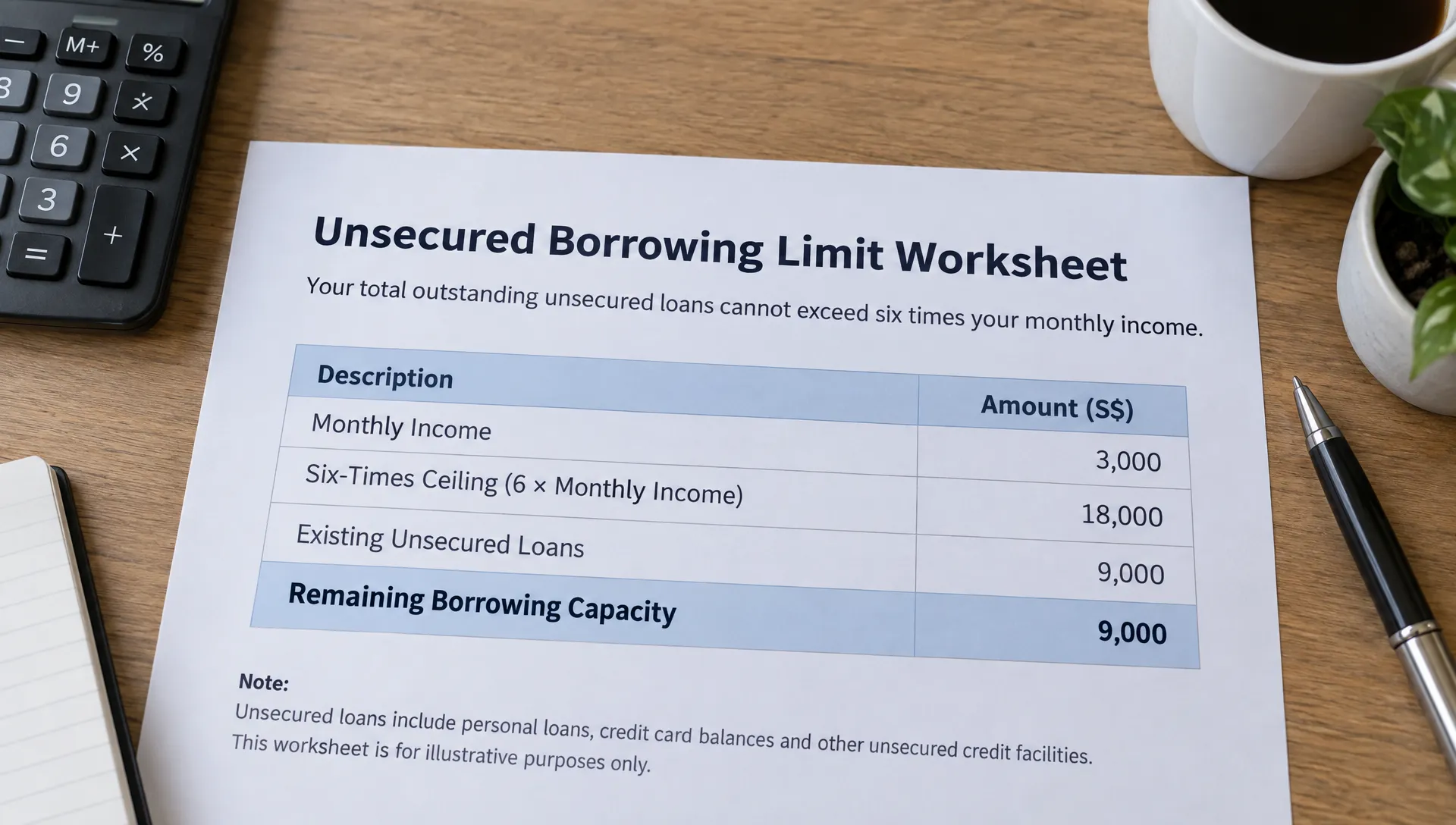
Suppose your assessed monthly income is S$3,000. Your aggregate ceiling is S$18,000. If you already owe S$7,000 in unsecured principal to one licensed moneylender and S$2,000 to another, your illustrative remaining capacity is:
S$18,000 − S$7,000 − S$2,000 = S$9,000.
That S$9,000 is potential headroom, not guaranteed approval. The lender must assess your current borrowing records and repayment ability.
The maximum personal loan amount in Singapore should be calculated using current outstanding borrowing, rather than simply adding together the original amounts of every loan you have taken. Before applying, check that your repayment records are accurate and clarify any recently settled balances.
Approved Loan Amount Versus Cash Received
The approved principal and the cash disbursed may differ. For licensed moneylenders, an administrative fee of up to 10% of the principal may be charged when the loan is granted.
For example, if an S$18,000 loan carries a 10% administrative fee deducted at disbursement, the borrower receives S$16,200. This is an illustration of the permitted fee ceiling, not a quotation of Swift Credit’s charges.
If you need a specific sum to pay a bill, checking the maximum personal loan amount in Singapore is only part of the calculation. You also need to know the net cash received, repayment schedule and total borrowing cost.
Swift Credit’s guide to moneylender fees and permitted charges explains the regulated fee categories. Ask for the actual charges in writing before deciding whether the offered amount meets your needs.
How Bank Personal Loan Limits Work
A Bank’s Advertised Maximum Is Not Your Approved Amount
Banks set their own personal loan product limits. An advertised maximum may depend on an income tier, an available credit limit or a specific eligibility category.
A bank can approve less after reviewing your income, credit history and existing financial commitments. For products that draw on a shared credit facility, amounts already used can also reduce what remains available.
Compare the amount you qualify for, rather than assuming the largest figure on a product page applies to you.
The MAS Borrowing Limit Is a Separate Restriction
The Monetary Authority of Singapore’s borrowing-limit framework establishes an industry-wide limit of 12 times monthly income for interest-bearing unsecured borrowing by borrowers within its scope.
Further unsecured borrowing can be restricted when that threshold is exceeded for three consecutive months. Certain high-income and high-net-worth borrowers are exempt from this particular restriction, although bank-specific limits still apply.
This framework is not a promise that a bank will lend you 12 times your salary. It also should not be confused with the six-times-income cap across licensed moneylenders. The maximum personal loan amount in Singapore must be assessed under the rules relevant to the borrowing route.
Choose a Requested Amount Below the Ceiling
Your legal borrowing capacity does not establish what you can comfortably repay. Start with the exact expense you need to cover, then check the proposed instalment against your monthly budget.
Include rent, household expenses and repayments on existing debts. Keep room for irregular costs instead of committing every remaining dollar to the new loan.
If the amount needed exceeds your remaining capacity, approaching another licensed moneylender does not bypass the aggregate cap. Reducing the expense or arranging payments directly with the bill issuer may be more suitable than seeking the largest available loan.
Frequently Asked Questions
Can I Borrow Six Times My Salary From Each Licensed Moneylender?
No. The six-times-monthly-income limit applies across all licensed moneylenders combined, provided your annual income is at least S$20,000. Existing unsecured borrowing reduces your remaining capacity.
Is There One Maximum Personal Loan Amount for Everyone?
No. The maximum personal loan amount in Singapore varies by borrowing route, income band and existing debt. Citizenship or residency status also affects the lower-income moneylender limits.
Does Being Within the Limit Guarantee Approval?
No. A borrowing limit is a ceiling, not an entitlement. A lender can approve a smaller amount or decline the application after assessing your income, commitments and repayment ability.
Request an Assessment Based on Your Needs
Swift Credit offers personalised loan assessments and applications through Singpass MyInfo, with verification at its Bugis office. Request the amount you need and review the proposed repayments, fees and net disbursement before accepting an offer.